"A commonplace book is what a provident poet cannot subsist without, for this proverbial reason, that “great wits have short memories:” and whereas, on the other hand, poets, being liars by profession, ought to have good memories; to reconcile these, a book of this sort, is in the nature of a supplemental memory, or a record of what occurs remarkable in every day’s reading or conversation." - Jonathan Swift, "A Letter of Advice to a Young Poet"

Showing posts with label Reviews. Show all posts

Thursday, February 20, 2014

REVIEW: The Girl Who Circumnavigated Fairyland in a Ship of Her Own Making

You may remember that this book was one of my Christmas presents to myself. However, it took two months and a very nasty cold to actually get me to read it. So first of all, if you are currently suffering from a cold or otherwise ill, bedridden, or just feeling lousy, this is the perfect book for you! When I'm sick, I always feel like regressing a little: staying tucked up in bed, eating comfort food, having other people take care of me. And truthfully, as I've discovered this week, the adult world has no room for sick people. Going to work with a stuffy nose sucks and is completely unprofessional, but go to work you must if you want to hang onto your Working Adult card. After work, though, you can quickly slip into your pjs, make a hot cocoa, and pick up this book. Because what better way to regress than reading a fairy tale?


The Girl Who Circumnavigated Fairyland in a Ship of Her Own Making (that's the last time I'm typing out the full title, by the way) is an especially delightful fairy tale. The author, whose excellent name is Catherynne Valente (perfect for writing fairy stories), seems to have been inspired by Alice in Wonderland, The Neverending Story, A Series of Unfortunate Events, and other favorites from my childhood. Her omniscient narrator is cheeky and droll and enjoys puns. Like Lewis Carroll and Lemony Snicket, she skews her writing to please children and adults simultaneously, without ever making her younger audience feel left out or talked over. Acutally, I imagine that children who read this book get to feel very grown-up and knowledgeable, because all of Valente's references and riffs are based on other children's stories. She picks out the tales in which we are all experts since childhood. In the same vein, I appreciated her use of multiple folktale traditions, not just the well-known European ones.

While paying homage to and riffing on various traditions, Valente brings her own particularly lovely voice to the telling of September's adventures in Fairyland - a blend of humor and wisdom. And the story itself takes plenty of unique turns. Each character that September encounters is fully realized and individualized. They fulfill the roles of the traditional folktale as they help or hinder the heroine along her journey, but they never feel like stock characters.

Valente also excels at making the world these characters live in feel real and tangible. Here's a bit from her description of a magical bath that September must take before entering the capital of Fairyland:

"Lye lifted September up suddenly and put her down in the first tub, which was really more like an oak barrel, the kind you store wine in, if you need to store rather a lot of wine, for it was enormous. September's head ducked immediately under the thick, bright gold water. When she bobbed up, the smell of it wrapped her up like a warm scarf: the scent of fireplaces crackling and warm cinnamon and autumn leaves crunching underfoot. She smelled cider and a rainstorm coming. The gold water clung to her in streaks and clumps, and she laughed. It tasted like butterscotch."

Descriptions like that make you want to dive right through the pages into that bath and explore September's magical world. Which is appropriate, since that is exactly what the book is about: a little girl who loves fairy tales and finds her way into Fairyland to have her own adventure.

Or, I should say, adventures, since this is part of an ongoing series. Two more books are out already, with very long names as well. I might not be able to wait until my next cold to read them, though.

Thursday, February 13, 2014

Review: The Book Thief

I've got quite a long backup of books I've finished but haven't reviewed yet, but let's start with one of the winners. The Book Thief has been much talked about and lauded, and the movie just came out this year (I haven't seen it). But the hype did nothing to diminish the impact this little book had on me. It really is one of the best books I've read in any of the genres it falls into: WWII stories, YA literature, books with experimental narrative voices. In particular, it was such a refreshing read after wading through some extremely clunky YA writing. [Side note/rant: My YA reading habit started as a welcome break from the heavy experimental fiction I read last year on my master's course. It morphed into an effort to familiarize myself with the YA section of the bookstore where I work. It has ended with annoyance at how the publishing industry ghettoizes and panders to teenage readers. But I digress....]

In case, by some chance, you haven't heard of this book, some orientation: The Book Thief is the story of Liesel Meminger, from the year she is adopted by the Hubermanns, a kind couple in a small town outside Munich, to the year that allied bombs start falling on that town. During that time, Liesel learns to read and grows from a child to a young woman. It's quite a modest scope of action, but set against the backdrop of WWII, it obviously takes on a larger meaning.

The book's seemingly small scope distinguishes it from the immense number of books published about WWII (I didn't realize quite how many there are until I lived in England, where that particular portion of history is still extremely vivid for many people). It doesn't set out to tell the whole story of the war or to encompass the entire (and unencompassable) tragedy of it. It doesn't even try to tell the whole story of Liesel's life. Her early childhood, before the Hubermanns adopt her, and her life after the war would probably be just as book-worthy, but Zusak chooses to focus on just the slice of her life that intersects with the war.

In fact, it's not really the war Liesel's story intersects with, but rather that of the other main character, a personified Death who narrates the book. It's rare to find a book with a really interesting narrative point of view, now that first person, collective voices, and unreliable narrators have all been tried out and worn out. But Zusak handles his conceptual narration extremely well. He often allows us to forget about it and immerse ourselves in the story but never actually breaks character, so that, when Death reassert itself as the point of view, it's never jarring.

This device also allows him to do justice to the wider historical significance of the events in the book, because Death, as we are constantly reminded, was kept very busy during the war years. To Death, Liesel's story is a distraction, but a welcome one that represents a glimmer of humanity amid the rampant inhumanity of war. That, in essence, is the function of almost every WWII story out there. Through the framing of Death's narration, however, Zusak acknowledges that directly. The taking on of Death as a narrator turns out not to be a presumptive literary trick, but a way toward greater humility in telling a single story, especially that of a German, during WWII.

Monday, January 27, 2014

Review: Tristan & Yseult @ Berkeley Rep


I've been wanting to write about this play for a while, and now that I've gone back to see it a second time, I think it's about time to put my love for it into words. It's a rare treat to see a live theater piece twice, and it usually requires repeating the experience pretty soon, before the show leaves town. But with Tristan & Yseult - or with any show by Kneehigh Theater, for that matter - there's so much richness to the production and so much happening on stage that the second time was as fresh as the first.

Actually, this particular play seems to invite you to return. It's based, after all, on a very old and very often retold story. The mythic, doomed love of the two main characters has been repeated in hundreds of different ways and forms, and Kneehigh's production acknowledges that while putting its own twist on the tale.

First, a little background: Kneehigh is a theater company based in Cornwall. Many of the actors have worked together for many years, and all of them are insanely talented. They sing, dance, play instruments, do acrobatics - oh, and act. During rehearsals, the entire company lives and works in a set of isolated barns in Cornwall, and their total unity and playfulness together onstage shows how important that practice is. Finally, they aim to tell stories from or about Cornwall itself, whether contemporary or ancient.

In the case of Tristan & Yseult, Kneehigh blends the old with the new. One character, King Mark, speaks in rhyming verse - a nod to the old tale - while the others speak normally. The production is suffused with music, including extracts from Wagner's Tristan und Isolde, original music that hearkens back to medieval ballads, and pop hits about unrequited love from only a few decades ago.


Most of the songs are (flawlessly) delivered by a live band called the Club of the Unloved. The Unloved also become the chorus of the show, commenting on the action, and sometimes even stepping into the raised, circular platform in the middle of the stage to inform or encourage the central characters at crucial moments. The chorus could be a reference to another tradition of ancient storytelling - Greek drama - except that, over the course of the show, they become as sympathetic and individuated as the protagonists. With this modernist twist, Kneehigh's production turns our attention to the average, unremarkable characters. The Unloved, the show asserts, deserve to tell their story as much as the lovers Tristan and Yseult. Slowly, characters from the central story join the chorus - King Mark, who loves Yseult; the maid, Brangian, who loves King Mark; and others who reveal the tragic ripple effects of the central love story.


The production presents a very complex and sophisticated version of an old tale, but its style is often charmingly simple and transparent. There are no set changes, and the architecture of the set is plain to see: a central circle that draws our attention to the dichotomy between beloved heroes and unloved onlookers, a mast-like pole that evokes Tristan's sea voyage, a platform for the band, and a raised walkway for dramatic entrances and exits. In one scene, the chorus members transform the setting into a forest simply by donning some outrageous fern hats and manning a collection of dove hand puppets that flap around the stage.

Allowing us to see the mechanics of theatrical storytelling is one of Kneehigh's trademarks. Although the stage is constantly busy and the choreography complex, no element is extraneous. They never dumb things down or smooth things over for the audience. Instead, they present us with a delightful jumble of song, dance, and poetry, and of tragedy and comedy - just enough to spark our own imaginations - and allow us to fill in the rest. In this play in particular, which celebrates the average and the unloved, it is easy to slip completely into the world of the production, supplying emotions from our own experiences of love, or its lack. So, in substance and style, Tristan & Yseult is a remarkably accessible production for any kind of modern audience, though, at the same time, it recalls the particular history and heritage of Cornwall through an ancient tale.

Friday, November 29, 2013

Review: Catching Fire

I'd forgotten how good this story is. And I think it's the mark of a good adaptation when the movie reminds you of how much you love a story and makes you want to go back and read the book over again. Catching Fire was pretty much everything I wanted it to be - although, that said, it's been a nice long year-and-a-half since I read the book, so I was in a perfect place to enjoy the movie without noticing any glaring omissions or glosses. I'll reserve judgement on those details until I re-read and re-watch. But this was a truly enjoyable film, well-paced, well-acted, well-directed, well-designed.


Middle movies are the best - this time around, we didn't need to be introduced to the characters or the world. There's no awkward exposition in this movie. A few elegant shots remind us of what's come before. One of the best is when, at the very beginning, Katniss aims to shoot a wild turkey in the woods back in District 12 and at the last moment sees herself shooting Marvel, the tribute she killed in the first games, instead. That one image was such a good reminder, early in the film, that there's no way Katniss (or we) can forget what happened in the previous movie. She and Peeta and all the other victors we meet later in the movie are seriously damaged and changed by what they did in the arena.

Portraying that psychological damage is one of the best, most unique things about Collins' books. Unlike most stories about heroes and heroines who endure incredible physical violence, the Hunger Games trilogy honestly shows how much that violence hurts people, physically and psychologically. When they're back in the arena, the characters also spend more of their time running in terror or lying on the ground, incapacitated by pain, than they do fighting or acting brave. I really appreciated that the movie lets its action heroes and heroines remain human even as they achieve superhuman things.

 
The actors really stepped up to the task of embodying both human fragility and human strength. I felt I knew what was going through Katniss's head at all times, which is important for an adaptation of a book that was told in the first person. And although there never seems to be enough time in movies for just watching the characters grow, Catching Fire did show a lot of character development. Peeta in particular undergoes a wonderful transformation in this part of the story (which makes part three even more heartbreaking). His strengths come to match Katniss's, although the two don't overlap. As I watched them struggle differently but bravely with the pressures and horrors of the victory tour and the arena, I was totally convinced that, together, they could actually change the society that was oppressing them.


Meanwhile, Gale starts to look worse and worse in comparison, as he consistently ignores everything Katniss is going through and just keeps asking her whether she's in love with him yet. He becomes, in some ways, the same as the spectators who so eagerly lap up Katniss and Peeta's staged romance. Peeta, on the other hand, accepts Katniss's feelings and gets on with the more important stuff, like helping her save her family or comforting her when she has nightmares about the arena. When Gale sees Katniss recoil in shock after her vision of shooting Marvel, by contrast, he has no idea what to do.


All of this points not only to how much better Peeta is than Gale, but also how much better Suzanne Collins is than most authors who focus on their heroines' love lives over everything else. One of these boys understands that Katniss is more than a sex object, and he's obviously the one she should ally herself with if she wants to save the world and wants to have a chance at happiness doing that. Collins also exposes how the society objectifies Katniss. The best way to keep her from starting a rebellion, as Plutarch Heavensbee suggests to President Snow, is to paint her as a classic feminine stereotype, more obsessed with her wedding dress than concerned about politics. That's why Cinna's transformation/destruction of that dress is such a good image. On the one hand, he literally burns up the dress to show that she's more than the barbie doll that the Capitol wants her to be. On the other hand, when she spreads her wings as the Mockingjay, she's still expressing her identity through a dress, a foreshadowing of the fact that she'll become as much a puppet of District 13's rebellion as she was of the Capitol.


This is also why I loved Joanna's undressing-in-the-elevator scene. She recognizes exactly what those fancy clothes mean, and she isn't having any of it. She'd rather go naked than conform to anyone's idea of who she is. It’s also a priceless scene, which the actors play for comedy very successfully. But, as is appropriate for the story, even this comedic moment is overlaid with the themes of the film. The Hunger Games trilogy is a critique of those who thoughtlessly create and consume entertainment, and it forces its own audience to really think about what they’re watching and to decide for themselves whether it’s entertainment or something else.

I loved all the new characters, Joanna included. The casting was right on the nail for everyone, and the movie succeeded in presenting clear, though necessarily brief, portraits of each of them. Haymitch also acquires a lot more depth in this movie simply by being presented alongside his friends, the other victors. One details I did miss from the books was the scene where Katniss watches the video of the games from the year Haymitch won. But I admire the directors for knowing when to cut scenes like that and achieving a coherent and lean movie in the end.


In addition to being well directed and acted, the movie was beautifully designed. The arena looked pretty spectacular, especially in the aerial shots. And once again, the movie fleshed out a more vivid, tangible world than the books presented (thin physical description and world-building is one of the main flaws of the books, in my opinion). I look forward to seeing how the filmmakers show us District 13. Only a year to wait, but the brilliant series of short scenes and spare shots at the end of the movie definitely whetted my appetite and are making that year seem very long indeed.

Monday, November 25, 2013

Review: Matched trilogy

It's been a while since I blogged, but in between starting a new job, gearing up for the holidays, and adjusting to life after school and back in the US, I have actually managed to keep reading. After a few random 'literary' novels, I was craving some easy, plot-driven books that wouldn't be total drivel.

YA dystopias fit those conditions perfectly. I love dystopia because it involves imagined worlds but still makes you think about the real world. And although Ally Condie does a little too much telling and uses quite a few too many symbols and metaphors, the Matched trilogy definitely made me think.

First, these books made me think about myself. The first book introduces us to the Society. It's important that it's written with a capital 'S' because a lot of things in this book are identified by normal nouns turned into proper nouns by a capital letter. That's because there are no multiples or options or choices in this world. There is one government, one country, and one right answer to every question. Each person is matched with their one perfect 'match' and one perfect job. They have one set of clothes. And they act as one, all obeying the same laws. (There is also, we learn, one rebellion trying to take down the Society, but even it is called the Rising, a foreshadowing of the fact that it turns out to be hard to distinguish from the system it's trying to replace.)

I found this world-concept especially interesting because one of the things I dislike most about contemporary society, especially in the US, is the excess of choice it offers its citizens. All you have to do is go to Bed, Bath & Beyond and try to pick a new set of bathroom towels to understand what I mean. There are so many variables and options for everything we buy - do you want organic or conventional, non-fat, low-fat, or whole milk? While shopping for apples this week, I must have been offered at least 20 varieties of just that fruit. Personally, this stresses me out, and as I read about Cassia Reyes, Condie's heroine, I had just a twinge of jealousy because she didn't have to make those ridiculous choices all throughout her daily life. Condie really succeeded in imagining a future world that seems to have solved a problem our society actually suffers from - only they took the solution too far.

It's not just Cassia's meals and clothes that are determined for her. She also gets no choice in the person she'll spend her life with, the job she'll spend her life doing, and the city she'll spend her life in. Luckily for her, she gets matched with her best friend, Xander. Unluckily, she is mistakenly matched with a second boy as well: her other friend, Ky. And so Condie has a perfect little set up to explore the concept of a character who has to learn what it means to choose between two options and, later, how to create her own ideas and her own future outside of the options presented to her.

The first book, Matched, starts out looking like a pretty conventional teen love triangle. But as the series develops, the initial set-up of Cassia being torn between Xander and Ky gets woven into a much bigger story about her relationship to society, not just to a couple of boys.

Again, this all felt so familiar. Beyond over-stuffed supermarket shelves, the US (foremost among rich nations) pretends to offer its citizens unlimited possibilities in what kind of life they can lead. Supposedly, anyone, myself included, could become president someday. That's not strictly true, of course - there's a lot of inequality and a lot of glass ceilings still around. But this book responds in interesting ways to that American Dream. In a lot of ways, Condie's message is very traditionally American: she celebrates the moments when Cassia breaks away from the Society by running away into untamed nature or expressing herself through her own poetry, music, and dance. There's even a refrain throughout the books, referring to the anonymity of the leader of the Rising: Anyone could be the Pilot. This sounds a lot like saying, Anyone could be president of the United States.

But in the end, Cassia returns to civilization to help build a better society having learned that there are no easy choices, and possibilities are not unlimited in any part of life. She can't choose both Xander and Ky, or both the Society and the Rising. She can't live in both her home town and the wild canyons she discovers in Crossed and comes to love. She can't divide herself when some of her friends choose to leave for unknown lands while some decide to stay and rebuild. Choice is good, but choice is also hard.

I don't recommend these books based on the writing style or the psychological depth of the characters, who are lovable and relatable but also fairly simple. This book adheres to the (I think absurd) rule in YA that psychological depth and elegant, show-not-tell writing be banished along with violence and sex.

But despite its flaws, this trilogy was a very good read. I wanted to find out what happened to the characters, and the books delivered the plot at a great pace, not too fast and not too slow, just enough to keep me desperately turning the pages. And when I stopped turning those pages and headed to work or went to make another cup of tea, I wasn't just thinking about who Cassia would end up with at the end of the third book. I also found myself thinking about my own life and my own choices - engaging in just the kind of reflection that dystopian fiction is supposed to inspire.

Tuesday, October 22, 2013

Review: Animal Dreams

I picked Animal Dreams up for 10 cents at my local library because I'd enjoyed another of Barbara Kingsolver's books, The Poisonwood Bible. Now that I think about it, I read that over five years ago, and I honestly don't remember much about it, except that I liked it but found the ending a little too drawn out. Animal Dreams, on the other hand, is paced really beautifully and wraps up in a series of shorter chapters that delicately tie up loose ends and even leave one scene to happen "off-stage" although Kingsolver spends a lot of the book building up to it. It's a very quick, but very satisfying read. The writing is so smooth, the first-person voice so accessible that if, like me, you get completely sucked into identifying with the protagonist, the book just flies by.


That protagonist is Codi Noline, who goes back to spend a year in her tiny desert home town after essentially running away from a difficult and estranged childhood there. The arc of the book is her attempts to reconcile with her family and other people in the town as well as with herself. What I loved about this book is that it shows the inaccurate and unhelpful habits in people's self-image that can keep them from living to their full potential. The quote singled out for the back of the book is about how our lives shape our dreams, just like how a dog who chases rabbits during the day dreams about chasing rabbits at night, but the book also shows the reverse: how if we don't dare to dream or hope for a certain kind of life, we don't end up living that life.

Codi's narration is interspersed with shorter sections told from the point of view of her father. In addition to these multiple voices, Kingsolver weaves together multiple strands of story. Codi's sister travels to Nicaragua to help solve an agricultural crisis while at the same time Codi is faced with an agricultural crisis in her own town. One of the central plot-lines is about Codi's relationship to the older women in the town, who turn out to be surrogate mothers she never realized she had. Another is her rekindling of a romance with Loyd, an Apache guy she dated in highschool.

It's possible Loyd fits into a stereotype of a 'wise Indian,' but I really liked his outlook on life as he describes it to Codi and enacts it throughout the book. A big theme of the book is people's relationship to nature and place, and he has a lot to say about that. I also really liked how Kingsolver handled Loyd and Codi's relationship. It's refreshing after reading and watching so many books and movies where the courtship is everything and the happily ever begins the moment the destined couple kiss. In this book, Loyd and Codi already went through all that in high school, so instead, Kingsolver allows them to pick up where they left off and describes both the challenges to their happiness and the simple, comfortable moments as they sit side-by-side on a porch or take a long drive together.

Finally, I really enjoyed the imagery of the Southwest - the tiny town Codi has such difficulty negotiating, and a Pueblo she visits midway through the book. I love the desert, and it was nice to read about it as described with such ease and vivid particularity. I will definitely be reading more of Kingsolver's books - I already picked up The Bean Trees, which I've heard is great - but I think I'll be thinking about this book for a long time to come.

Saturday, July 20, 2013

Review: The Bling Ring

I wanted to see this movie for a few reasons. First, to see what Emma Watson's up to. Second, to finally see a Sophia Coppola movie. Third, for the chance to spend 90 minutes in the southern California sun.


And I definitely enjoyed it. There were some really interesting shots, great performances, and obviously, given the subject matter, killer costuming. I was especially happy to finally see Coppola's style - and it really is a style, which is wonderful. I love watching director's movies. Even when the directorial touches are light, like her use of obvious, jarring music or her choice of a few unconventional framings for key scenes in the movie, they give the film shape and a kind of consciousness - or maybe conscientiousness is a better word. It makes the film feel crafted.


This shot, for example, takes the point of view of one among many cameras directed at the characters' lives - news cameras, security cameras, phone cameras. It's not so much to make you feel alienated from the story, but enough to make you briefly remember your position as a viewer and briefly consider the angle from which the story is being told.


That angle is for the most part slanted toward Marc, the one guy in the group of five teens who decide to start stealing from celebrities. Except only one of them really decides. After Rebecca leads a puppy-dog Marc along on a few preliminary break-ins, the rest of the girls fall in without, it seems, a second thought. This is a bit difficult to believe, but then what these teens did in real life is also difficult to believe. I kind of expected Coppola to explore the motives behind the craziness, and she does to an extent.
Very subtly, she suggests the parallels between the teens and their famous victims - such as the way the victims carelessly leave the keys to their mansions under their doormats while the teens carelessly boast about their conquests to the friends who eventually turn them in. But I left the film with a lot of lingering questions about what was going on behind those beautifully made-up faces.


Again, very subtly, Coppola does convey the effect of the crime on the main characters. It comes through in the shift from lazy beach hangouts at the beginning of the film to a frantic cocaine montage near the end. It comes through in the different ways they break down upon arrest. Watson in particular did such a good job that I almost felt sorry for her, until I remembered how she'd wound up in that cop car.


The film doesn't excuse or explain what happens in it, which I liked. I just wish Coppola had trained her impartial and keen gaze a bit longer and looked a bit deeper at the characters. There was one scene I especially loved: Rebecca and Marc are driving in the dark, and the camera sits just behind them, in the middle of the back seat, so we can't really see their faces, just the partially-lit road ahead. Marc asks Rebecca if she would ever rob him if they weren't friends. Rebecca says something like, "I would never do that to you." And yet by the end, she betrays him. That one scene takes the characters fathoms deeper without even showing their faces and opens up new questions about the meaning of robbery, wealth, friendship - all the themes of the movie. I wanted more of that.


Sunday, June 9, 2013

Review: Cosmopolis

Another read for my dissertation, picked because it's about cities and modernity. I got through this book in a couple of long days of reading, and it does have a way of sucking you in. The whole book (with a few exceptions) is set inside of a limo driving around NYC and, more specifically, inside the mind of Eric Packer, its bajillionaire passenger. This is not the nicest space to be in for 200 pages. Eric is, quite frankly, a strange guy, with very weird relationships to the people in his life who climb in and out of his limo. These include his wife, his body guards, his doctor, and his various assistants and employees. Actually there's no one likable or easy to relate to in this book. The fascination it holds is more the fascination of peering in at some weird subculture than the fascination of learning something about humanity or yourself (although maybe DeLillo would say that we can learn about humanity and ourselves from getting a glimpse of Eric's life).

The style of the book isn't very friendly either. The characters talk in some kind of strange mixture of philosophy professor and New York slang. Maybe that's how multi-billionaires in NYC actually talk, but for me it just felt like another thing distancing me from the characters, making them sound like the mouthpieces of DeLillo's abstract ideas about modern life.

What I found effective about this book was actually precisely what I'm complaining about - that it makes the city strange, as if by putting us inside this limo, DeLillo has plucked us from earth and put us in an alien spaceship so that we can see our lives from a totally new perspective. Eric does in some sense live above the world. However, his perspective doesn't offer much insight. Maybe the space ship is just too high up (excuse me while I beat this metaphor to death), so that the view becomes too simplified.

This was my first DeLillo novel, and I don't think I'll be reading any more of his writing. It was just too rarefied, too fascinated with messed-up people in a messed-up world, too stylistically stilted for me. But I'm glad I read it, as part of my goal to become better-versed in contemporary literature. Now if someone brings up DeLillo at a dinner party, I'll have something to say.

Wednesday, May 29, 2013

Review: Specimen Days

I read this as background/margin reading for my dissertation, so I was mostly reading for content that related to my main topic. However, I thought I'd write up a few thoughts on the book itself.

Cunningham tells three different stories, which are in some senses the same stories. They cover what some people call the three industrial revolutions - the mechanization of labor in factories in the 1800s, the advent of computers and other telecommunications in the present day, and the future of biotechnology, in this case spreading to artificial human life. Each story has three main characters, Luke, Catherine, and Simon,whose names and general characteristics stay the same across the whole novel, but who also change to fit each story.

This conceit worked pretty well for me, and I found the moments of time well-chosen. For my dissertation, I've been reading a lot of books that use multiple narratives or multiple times and places, or that imagine a near future, or that use reincarnation as a motif. Although it's a very literary novel, it was also a bit of a page-turner. Each story felt like it was heading inevitably toward something that would probably be terrible, but that I couldn't wait to discover (oh, the suffering we put ourselves through in reading!). I suppose I'd say the best thing about this book is the plotting, both in the normal sense of suspense and pacing and meaningfulness of events in the book, and in the larger sense of how Cunningham constructs his three strands and their overlaps.

What was missing for me was a sense of connection to the characters. I did find them pretty interesting, especially the narrators of sections one and three, but the writing felt a bit distanced. The artifice of the entire structure and the concept made it hard to believe in the characters as people, rather than as literary symbols. As they started to repeat, in variations, over the three stories, each previous incarnation of Luke, Catherine, or Simon began feeling less real. I couldn't help imagining Cunningham sitting at his desk inventing these characters and manipulating them so that they would fit equally well into each story - with the result that they don't fit snugly or perfectly into any story.

The other major element of this book is Cunningham's use of Walt Whitman's poetry - in each story, the narrator has a very special relationship with Whitman, and his verses keep popping up throughout the narration. I haven't read him at all, and I caught myself skipping over the longer excerpts because they were a bit opaque. But nevertheless, the repeated lines of verse made a kind of background rhythm for the whole book even as the individual narrator's voices changed - a kind of fourth voice that spanned the whole.

I wouldn't recommend this book to the idle reader who just wants a good book. It wasn't hard to get into, but it was very easy to get out of. The imagery stayed with me more than the voices or the emotions. A worthwhile experience, but not an entirely satisfying one.

Saturday, March 2, 2013

Review: Number9Dream

And once again my love for David Mitchell is renewed. Kind of like with Virginia Woolf, I forget how great he is, and then I pick up another of his books and it overwhelms me all over again. Initially (having read Cloud Atlas and Black Swan Green), I admired him for his versatility and how well he handled such diverse stories, settings, characters, genres. Now (having added The Thousand Autumns of Jacob de Zoet and Number9Dream), I'm starting to get really interested in the recurrences in his writing rather than the divergences. Anyway, there's plenty to like in each individual book, too, and this one is no exception. Number9Dream is Mitchell's second of five novels, and I'll be reading his first, Ghostwritten, next, but for now, I'm going to try to explain my reaction to this crazy, crazy, charming book.

At its core, this is a very simple quest story about how 20-year-old Eiji Miyake goes to Tokyo to find his father. He's been brought up on a rural island, estranged from his mother and without ever knowing his father, so he sets out to discover this mysterious man. The only problem is, he doesn't even know his father's name, and Tokyo is a big place.

Actually, as Eiji pursues various schemes to find his father, it doesn't seem like such a big place after all. Almost everyone he meets seems to be connected in some way or another, and false trails lead him in an intricate but tightly woven network of people and organizations. One great thing about this book is how it portrays the city and the daily realities of city living - the extraordinary chance encounters, the deep sense of alienation, the changing rhythms, the peculiar mix of anonymity and total lack of privacy. By taking Eiji back to the same places throughout the book, Mitchell helps you really visualize Tokyo (even if, like me, you've never even been to Japan), and you really feel you're accompanying Eiji in discovering the place's secrets.

Some of these secrets are very nasty and quite incredible. But the entire book lingers on the edge between the mundane and the absurd - sort of like in a dream. The book opens with Eiji indulging in daydreams about reuniting with his father and ends with a thoroughly dreamy sequence where all of his experiences blend and transform themselves whenever he closes his eyes. Each of the eight long chapters, in fact, has a theme and a particular structure, and Mitchell is brilliant at weaving different sorts of narration, different times, different versions of reality together.

But - and this is what I love about Mitchell's novels - stringing all the dreamy, literary tricks together is a real, strong, human story. At one point in the book, when Eiji following up one of the many trails that seem to lead toward his father, I noticed that my heart was literally pounding, I was so caught up in his quest. Eiji tells his story in first-person, with a lot of honesty and charm, so that I completely identified with him from the first chapter to the last. He's like the best kind of hero in young adult novels (although I wouldn't categorize this as one, because it gets incredibly and disturbingly violent in a few places), who struggles with very human, ordinary problems like an inaccessible crush and the annoyances of a boring job between bouts of tracking down mysterious persons and escaping death. A bit like a non-spider-powered Peter Parker, Eiji alternates between normal life and crazy adventures and does it with both the flair we wish we had and the real emotional and physical vulnerability that we all do have.

This book makes you feel and think in equal measure, and, best of all, the two feel totally integrated. The literary experiments don't feel tacked on to the story at all. Mitchell is, as usual, completely in control of everything he does, knowing just how much your nerves can stretch, just how much you need to hear of a certain conversation, or just how much you need to jog your memory of a plot point from five chapters ago. It's a bit of a crazy ride, but he's got it under just the right amount of control. I had so much fun reading this book, and it's a definite five star recommendation.

Thursday, February 28, 2013

Review: An Instance of the Fingerpost

Drumroll please.....it's my 100th post on this blog! And in honor of that, I'm going to do something totally ordinary and write you a review of what I've been reading. Sorry, I really couldn't think of anything exciting this early in the morning. However, this is a really good book, so I guess that makes up for it.

Let me qualify: this is a great book for people who are both patient and curious. The former because it's 700 pages long and written in a the long-winded style of the 17th century. The latter because it's a murder mystery that not only reveals who did it, but also an amazing wealth of information about life and thought in Oxford in the 1660s.

This is a truly dynamic setting, because the place was crawling with now-famous scientists and philosophers - although, as Iain Pears shows brilliantly, the two were one-and-the-same back then. The characters who are interested in experimenting in science are also wedded to religious doctrine and manage to mix the two in really astounding ways. Instead of just telling us what people ate or how they dressed, Pears reveals how they thought, and how different their assumptions were to ours. There is one scene in particular of a chemistry experiment which shows how rudimentary the scientific method was and how exciting it was for people steeped in both Christian and ancient Greek dogma to discover these new ways of thinking.

The theme of scientific inquiry and truth (which fits so nicely into a mystery novel) intersects with a political strain. The book is set just a few years after the end of the Cromwellian era in England, a time when religious and political tensions were running very very high. Pears gives us four different first-person narrators, whose perspectives highlight different aspects of the era: Marco da Cola, a gentleman physician from Italy, Jack Prescott, a young man trying to prove his father was not a traitor to the newly restored king, Dr. Wallis, a very paranoid cryptographer who's enmeshed in both the old and the new regime, and Anthony Wood, an antiquary and historian who claims to be impartial in his writing of the events of the books.

As it turns out, none of them are totally impartial, and they all have different reasons for writing their versions of the murder and its solution. As I said, it takes a lot of patience to get through the same narrative four times and have the answer to the who-done-it question delayed for about 600 pages. But it's really such a rewarding read, because the four stories turn out to be very different versions, and Pears does a masterful job layering perspectives and timing revelations so that you are always on the brink of finding out another crucial bit of information.

The writing is old-fashioned, of course because it's written in first-person, but once you let yourself sink into it, it's very easy to read. I recommend this for a long week in winter with many cups of tea. Reading it in one weekend was like running a long-distance race (luckily one I've been training for the last six months), but I still appreciated this book immensely for what it taught me about the era, for giving me another amazing example of historical fiction, and for telling a good story that left me really satisfied.

Saturday, February 16, 2013

Review: Sacred Hearts

This is another book from my historical novel syllabus, and the first I've been disappointed in. The story is set entirely in a Benedictine convent in 16th century Italy, and the main narrator is the dispensary mistress, Suora Zuana, but her voice is interspersed with the voice of Serafina, the newest arrival at the convent, who has been put there against her will. According to the author's note, this was a common practice at the time - women from various social strata and with different problematic backgrounds were forced into convent life. That's one of the novels historical revelations. The other is that these convents were not the stark, spartan cells one might imagine, but could be places for women to practice art - singing or composing in particular, for religious music - or, as in Zuana's case, to pursue the study of medicine.

Dunant sets her story at a time when that way of life - the relative freedom allowed to nuns within convent walls - is in danger of being destroyed by fiercer regulations and more of an emphasis on religious devotion. Moments of transition in history are always interesting, but Dunant actually places much more weight on the plot surrounding Serafina's resistance to convent life and Zuana's spritual/moral doubts about how to help Serafina.


It wasn't enough of a story to maintain my interest through three or four hundred pages, especially because Dunant never allows us to leave the convent or the women's minds. This really gives the novel a sense of claustrophobia and repression, because the nuns are cut off from the outside world and from their own impulses and desires and thoughts. They can never talk honestly to each other because there are so many rules about which thoughts are pious and which require penance. And even Serafina, whose rebelliousness at first brings some variety and relief, eventually starts to succumb to the influence of some of the most violently pious nuns.

This device - the closed world, the women sharing this intense relationship with each other and with their god - could have made a really interesting book, but Dunant doesn't take it far enough. She never really gets into her characters' minds enough to convince you of what it would really be like to live in a convent, or even in an era when religion was such an important part of life, a given, whether you were in a convent or not. Instead of real psychological study, we get a lot of repetitive reflections on god, regularly interrupted with sensational plot twists. These really undercut the effect of the claustrophobia, because while we're supposed to be sympathizing with the women's self-denial and suffering, Dunant gives us everything we want - a love story, an escape attempt, tense politics, a mystical nun, even a kind of chase scene through the convent at night.

It's funny, I thought I was going to really enjoy this as an easy read after so many bizarre, experimental novels, but I got really frustrated because when I indulge in an easy read, I want it to be a really good easy read. If for some reason, you can't get enough of renaissance novels or love reading about religious life, I guess you might enjoy this (quite a few people in my class loved it). Otherwise, I advise you choose a different book.

Friday, February 1, 2013

Review: Shame

Not to be confused with the movie. This is not a book starring Michael Fassbender. Probably the only thing it shares with that movie is that it makes its audience uncomfortable, in this case, by setting up heros, storylines, and an identity as a historical novel, and then tearing each of them, carefully, lovingly, apart, gutting them, and hanging them out to dry like carcasses (the simile is particularly apt for the book, as it's full of corpses and grossness). I don't recommend this book for the lover of the book equivalent of Jane Austen adaptations. Or maybe I do, because it attacks the idea at the heart of classic historical fictions - the assumptions that history can be told as a straightforward narrative and consumed for idle pleasure and escape.


The book is set in the aftermath of Pakistan's separation from India and follows the intertwined fates of three families - the Shakils, the Hyders, and the Harappas - who intermarry, feud, succeed each other as leaders of the new country, and eventually all die, more or less gruesomely. Oops, sorry, spoiler. Except it isn't really a spoiler. First of all, Rushdie has a frustrating/tantalizing habit of telling you what's going to happen before he gets there in his story. He'll hint at someone's demise or future, then loop back to continue the novel chronologically, leaving you simultaneously annoyed that he gave away the future, and impatient to get through the present. But wait, didn't I say it was a historical novel? So the future of the novel is our past, and we know that all these characters are not only fictional, but also already dead in the parallel chronology of historical fiction.

Second of all, Rushdie makes the idea of spoilers a moot point by systematically disengaging us from sympathy with any of his characters. Even the man he labels as his 'hero,' Omar Khayyam Shakil, is painted as terribly unappetizing, and Rushdie even devotes a couple of pages in the middle of the book to how disappointed he is in his hero, how morally repugnant Shakil has become, what a lousy hero he has turned out to be.

Finally, Rushdie sets up, rather brilliantly, a very particular atmosphere that makes each character's fate seem inevitable. As the story progresses, each piece seems to fall into place as thought we knew it would belong there all along. This is partly because of the way Rushdie constantly hints at the future, but also because of his use of magical realism. There's a really strong sense of Fate with a capital F, some ulterior force (History with a capital H?) drawing all the characters along their tangled paths toward the ultimate roles they will play in each others' lives and in the history of their country.

So, without a linear chronology, an emotional through line drawn by a certain character, or the rational worldview of cause-and-effect that one might expect...well, spoilers just don't seem that relevant.

This is not a fun book to read, but it is fascinating. Rushdie has a great command of storytelling techniques, even though he breaks a lot of the rules, and I found myself almost morbidly riveted to the book, disgusted by intrigued. And the book certainly sparks interesting questions about the forms historical fiction can take, and the purposes of writing about history. Rushdie's authorial voice is very strong, and he comes in as himself every so often to talk about the events (stories of Pakistani immigrants in London, for example) that inspired the book. He manages to seem incredibly honest and transparent about his process and goals, and at the same time to slip you into such an intricately woven pattern of different realities and different voices (he's especially good with character's voices and the use of dialect) that you barely know where you are. And that's the point of the book, I think - or one point - that history is deceptive, that we can't trust it, but that it is seductive and compelling all the same. He advertises the book as a fairy tale but winds up saying a lot about both the nature of storytelling and about the reality he's trying to tell.

Saturday, January 19, 2013

Review: Waverly

The proper name of this book is actually Waverly, or 'Tis Sixty Years Since, which helpfully reminds you that although it was written in the past, it is also written about the past - apparently the first historical novel in the English cannon. And it is also the first novel I've read in months that professes to be out simply to please you, not to educate you, shock you, or dismember your mental faculties until you are left with a shambles of a sense of reality.

Well, Sir Walter Scott, writing anonymously, did want Waverly to educate people. As a scot, Scott (ahahaha, I'm amazed more people don't make this into a poor joke) wanted the english to better understand and be more sympathetic toward the unfortunate Jacobites, supporters of King James Stuart, who rose of in Scotland twice during the 18th century and twice were quashed. It's not a political novel as such, because by the time Scott was writing, in the early 19th century, the rebellion and the question of succession were pretty much history - two generations gone. But the novel is definitely trying to show the highlanders and other Jacobites in a fair light without espousing their political cause.

I read this for class - otherwise, I probably wouldn't have made it all the way through, because it's very old-fashioned indeed. But I ended up really enjoying both the story and the very-present, but pleasantly ironic authorial voice that comments on the action and reminds you what you're feeling and what your hero's feeling at all times.

This hero is Edward Waverly, a young and very romantic man who goes up north from his English estate and gets caught up in the Jacobite rebellion, not because he's a great political leader or even a great soldier, but because he is in love with the ancient, fading highland way of life, and he makes personal connections with many of the rebels. There's much saving of lives, pledging of fealty, and heaving of tormented bosoms, but Scott's awareness and exploitation of Waverly's innocence and idealism gives it all an edge and doesn't require you to take it too seriously. The things that happen to Waverly first feed directly into his romantic dreams and then begin to unravel them, so it's both a national story and a coming-of-age story.

A lot of people in my class found it dull and slow-going and had trouble with the archaic language. For whatever reason, I got through the difficulties, though, and enjoyed it a lot. There were even moments (brief moments) when I didn't want to put it down and go make a cup of tea, because I had to know what was going to happen to poor Waverly and his friends. I also enjoy the challenge of sinking into another form of language, whether it's a foreign one or foreign version of my own. Probably that's the language major in me.

The question of language is particularly interesting at the moment because I'm starting work on my own historical novel project. I'm writing about France in the 17th century, but in English, so I not only need to imagine what the characters would have said and thought, but also need to translate that into English and once again into modern parlance. Last night I started re-reading Wolf Hall, and am just amazed at how Hilary Mantel manages to make medieval characters sound ancient and modern at the same time. I keep trying to skim it, because I'm short on time, but it's so good I just want to read every word over again. If you haven't gotten around to reading it since I reviewed it over the summer, I recommend it again heartily.

I also recommend Waverly, but only if you enjoy classics and sweeping narratives and want to spend hours imagining yourself tramping around Scotland with a sometimes silly, but also often endearing protagonist and also, of course, with Scott's authorial voice. If, like me, you're semi snowed-in, it's a great curl-up-by-the-fire read. So is Wolf Hall. This is definitely historical novel weather, when you want to dive headfirst into another world and linger there for hours, which is exactly what I'm doing this weekend. You can imagine me floating from Henry VIII's court to Paris's literary salons, with a brief detour through the kitchen for breakfast.


Tuesday, December 4, 2012

Review: The Emigrants by W. G. Sebald

I have to give a presentation on this book on Thursday, so I did another marathon Day of Reading today (there've been a lot of those lately). Now I'm too tired to read any of the articles and reviews I'll need to do my presentation properly, but I thought it might help to write down some impressions of the book here while it's still fresh in my mind.

This is not a book I would have finished if it weren't for class, but I'm very glad I did. It consists of four sections, each labeled with a name. They tell the stories (put together by an unnamed narrator whose life parallels Sebald's so closely that I had to look it up to make sure it was really a novel) of four Jewish men who emigrate from Germany to England or America over the course of the 20th century. 

The first thing that threw me off was that the sections are not equally weighted. The first is really brief, a glimpse into a life with which the narrator briefly crossed paths. But each section is longer than the one that precedes it, and each story is more nuanced, with more voices adding their perspectives (voices that the narrator gleans from journals, conversations, and interviews). The stories also seem to circle closer and closer to the Holocaust, from the lives it touched to the lives it ended, but the scope of all the narratives together covers both world wars and much other German, English, and American history besides.

What I thought would be a book about the Holocaust turned out to be a book with truly universal insights into the experience of exile. It's about the reasons people leave home and the things it does to them, a topic quite close to me right now.

But this book was also very interesting structurally. The text is interspersed with black and white photographs, which are presented as samples drawn from family photo albums that the narrator came across as he researched various personal histories. This was another reason that I kept thinking the book must be non-fiction, or at least thinly disguised fact. The photos are not cited, so either they really are photos of the people Sebald is writing about, or they are photos of other people, who remained anonymous - a slightly unnerving prospect. I'm very curious to find out more about the sources of these photos in researching book more, but for now the faces scattered throughout the book are a mystery to me.

(This connects to a discussion I had in class yesterday about para-text and the cover design of classic literature - trends like the endless reprints of Jane Austen with painted portraits of anonymous Austenesque women who sometimes have nothing distinguishing in common with the characters in the book. With newer books, I always find myself a bit puzzled by the number of covers with photos of stock models on them, often enough young women with their heads cut out of the frame. I'm never sure whether I'm supposed to imagine the characters as they appear on the cover or not. But Sebald seems to be pushing the envelope by blatently juxtaposing photos and text and seeing what happens. I'm not sure yet exactly what happens, but it was a different reading experience and it challenged my expectation of what fiction should look like.)

The other interesting structural choice is the way in which stories overlap and become confused as you progress through the four sections. This reminded me a lot of what Faulkner does with storytelling and the recollection of the past in Absalom, Absalom!, except that all his narrators circled around one particular family history, whereas Sebald's narrators are mostly all telling their own stories. It's just that those stories start to seem more and more like one story, with landscapes, memories, dreams, and names crossing and recrossing over time, over land, and over a constellation of individual consciousnesses.

I was warned before starting the book that Sebald can be a little dry, and it's true that his prose is nothing special or fancy. But he clearly has a lot of control over language and storytelling. I'd like now to go back and read this in the original German (I didn't realize it was a translation until I sat down to read it) and see what other reflections and echoes the writing might reveal among all the stories. In any case, I liked this book a lot more than I thought I would, and I'm intrigued and ready to learn more when I get to work on my presentation tomorrow.

Monday, December 3, 2012

Review: Silver Linings Playbook

So I haven't done one of these for a while! But I love reviewing movies, almost as much as I love going to the movies, and last night I went to see Silver Linings Playbook as a way to get out of the house and see friends and get my mind off schoolwork for a few hours. I had seen the preview and thought it looked appealingly American and funny - two good qualities for a literature student in England, because, you know, a lot of dark and weird books to read and a lot of missing America. The movie wasn't exactly what I was expecting (although it is both very American and very funny), but the unexpected was all to the good. So here you go, a movie you should definitely see if you have any interest in what it's like to be diagnosed with a mental illness, or be undiagnosed with a mental illness, or fall in love, or fall out of love, or be American, or just be a person. I recommend it.
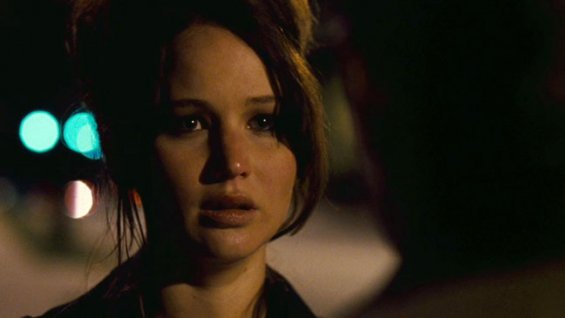
This picture basically sums up what I felt like during the first, maybe 15 minutes in the theater. Pat Solitano gets out of a mental hospital and goes back to live with his parents in Philadelphia and things aren't going well. For a while, it seems like the whole movie is going to be us following Pat's doomed attempt to "get in shape," physically and mentally, for his estranged wife, Nikki - doomed because she has a restraining order against him since he beat her lover to a pulp and got diagnosed with manic-depressive disorder. This isn't giving anything away, because all that drama is the starting point of the story. The real meat of it is what happens afterward, the story of dealing with a daily routine of no job and pills to take and trying to stay optimistic when the only goal you're clinging to is basically unreachable.
 The first sign of how good this movie is, and what a nuanced portrayal of mental illness it offers, is the sometimes tragic, sometimes hilarious blend of financial and emotional disarray with unfailing optimism and really deep family love and loyalty that Pat finds in his parent's house. His mom's refrain at moments of crisis, that it's game day (the family, but mostly his dad, are big Philadelphia Eagles fans) and she's making 'crabby snacks', is so pitiful and yet delivered with such a bright hope that it seems to sums up everything about this family. Pat is still prone to violent episodes, his father has been banned from the Eagles stadium for getting in too many fights, and neither of them has a job while Pat's older brother is thriving in his work and his marriage. They all end up hurting each other with words and sometimes fists, but hurting each other is the last thing they want to do. It's refreshing to see family eccentricity portrayed alongside such palpable family love, to be able to laugh at them and feel for them without feeling caught out in either emotion.
Actually, it's not just a movie about family. It's also about a wider community, including Pat Sr.'s best friend who roots for the opposite team, Pat's friend from the hospital, who keeps trying to get out and being escorted back (a running joke but also a pretty heart-rending glimpse into the endless paperwork and bureaucracy in which he is trapped), and Pat's friend from before, whose marriage is making him crazier than the people who've been diagnosed with actual mental disorders.
And then there's Tiffany, that friend's wife's sister. (But before I say anything else, can we just take a moment to appreciate Jennifer Lawrence's face in this still? She's wonderful.) After her husband died, she got herself a diagnosis and plenty of pills, and there's a hilarious exchange between her and Pat where they compare notes on the horrible effects of various medications. The rest of the movie integrates her into Pat's quest to recover his life and his happiness, because she's searching for some of the same things.

 The relationship between these two doesn't progress in your classic rom-com or dramatic romance style. In fact, you're never really sure where they're headed, because they interact like real people - if a little more explosively, with more mortifying awkwardness and more drastic mood swings. They stutter and stumble and make fools of themselves and still manage to carry on and make something of it.
Throughout the twists and turns of the movie, the directors, actors, etc. manage to keep an impressive balance of pathos and humor. In other works that do the same, that combination can be pretty aggressive, making us pull up short mid-laugh as we come face-to-face with horror. But in this movie, the laughs are mixed more mildly with pangs of recognition and moments of real empathy. Over and over, it gave me exactly the kind of feeling you get in real life when things are so desperate they're funny, or when something so awkward and inappropriate just slipped out of your mouth that you have no choice but to laugh at yourself. There's a particular moment when Pat Sr. is enraged, out in the middle of the night in his pyjamas yelling at a neighbor's son who's been pestering them, and then, in the middle of his diatribe, he just stops and gives up his anger. You can see him just take that step back and realize how ridiculous the whole situation is and decide it's not worth his time. In a straight drama, he would bring his rage to a cathartic breaking point and come away with some deep realization. In a straight comedy his fury would grow to exaggerated proportions and be turned to comic effect. But here, we're allowed to be sorry and laugh, without feeling contradictory or hypocritical.
It's not really a spoiler to say that the movie has a happy ending, because it's not clear until near the very end what scenario would actually constitute a happy ending for Pat or anybody. But you don't feel cheated or condescended to by the ending any more than by the humor. This is an honestly and believably optimistic movie. Pat's drive to get better is a kind of American dream that's easy to get behind and rewarding. I walked out of the movie happy, not because I'd escaped into a fantasy utopia, but because I'd been given a new perspective on my world and my life that made things look no less hard, but much more full of silver linings.

Monday, October 1, 2012

Review: Gilead

I came to this book straight off of Ian McEwan's new novel, Sweet Tooth, which is a romantic spy story, so when I was faced with the prospect of an elderly reverand from Iowa writing a letter to his son (the premise of Gilead), I was a little discouraged. However, since I was reading this for class, I stuck with it, and it's amazing how this book grows on you. By the end I was practically in tears. So first of all, I must say that if you choose to read this book, then please be patient with it. It really is brilliant.

The form of the story, as I said, is a letter, and in that sense it reminded me of The True History of the Kelly Gang, but instead of an outlaw writing to his daughter on the eve of his death in battle, Marilynne Robinson takes on the voice of John Ames, a reverand writing to his young son on the eve of his death from a heart condition. So at first the stakes seem very low indeed. But this book also reminded me strongly of The Remains of the Day because Ames is, in some ways, an unreliable narrator whose story conceals more than it reveals about the fraught lives of the people of Gilead. Over the course of the book, we glean bits of insight, not only into Ames' life, but also those of his father and grandfather and of his friend Reverand Boughton and his family, particularly his wayward son, Jack. The two families' stories are woven together around themes of faith, honor, and fatherhood. (And if this all sounds like a very male-dominated book, not to worry. Robinson has written a kind of companion novel written from the perspective of Glory, Boughton's daughter, which I'm looking forward to reading.)

Having said that Ames is unrealiable, I need to clarify by adding that he strives very hard to be as reliable as possible. He says over and over that he's trying to be honest, but over and over he finds himself hemmed in by his own stringent morality. He prides himself on never speaking ill of anyone, and so he finds it extremely difficult to recount the story of the various characters' failings - some of them very extreme (I won't give them away, because not knowing what exactly Ames was trying to shield is what kept me going until the end of the book).

Although this reticence can get quite frustrating, it also feels completely organic to the character. I don't know what Robinson's own background is, but she certainly writes a convincing portrait of a mind steeped in religion. Ames laces his prose with Scripture, which he knows off by heart, and the same heritage of ideas and language permeates all the conversations he describes. This is the story of people brought up with a strong sense of faith and charity who nonetheless find themselves confused and troubled in the face of historical and personal circumstance. From Ames' grandfather's questionable actions in the Civil War to Boughton's and Ames' struggles to forgive the impossible Jack, Robinson shows the limits of doctrine and at the same time the boundlessness of faith. Ames finds manifestations of god not only in his struggles with moral questions, but also, more importantly, in everyday moments of beauty and joy, in his observations of people in his town and his own enjoyment of his wife and son, whom he values above all else.

So although I have no religious feeling or knowledge of Christian belief, I found myself entirely drawn in my Ames' reflections on his religion. This book is a fascinating window into American history, especially around the Civil War, and into a distinctly American code of faith and morality (Ames' life is set against that of his brother, who travels to Germany to read philosophy), and an equally fascinating portrait of a mind and a life woven through with historical, cultural, and social circumstance. I really could be considered a meditation on the meaning of individual existence within that network of history and present. But unlike many meditations on existence, this one left me with a really positive feeling. It's a tough book, but not an entirely sad one.

Now I must run off to class to discuss it.


Saturday, August 11, 2012

Review: Wolf Hall

I mentioned a few times already that I was reading this book, and now finally I get to review it for you all, having finished it a couple of days ago. It's a book I'm very happy to recommend.

Basically, if you like historical fiction, you will probably love it. And if you don't like historical fiction, you may not love it, but it's worth a try.

In this book, Hilary Mantel, whose other books (which are many) I definitely want to read now, tells the story of Henry VIII and his wife-troubles, a well-worn tale. Except that she actually tells the story of Thomas Cromwell, which is one of the things that makes this book distinct from and better than most historical novels. Cromwell was a commoner, the son of a blacksmith, who rose to become assistant to Cardinal Wolsey and Henry's closest adviser.

He is a brilliant choice of narrator, because of course he lends an outsider's perspective on the world of court intrigue and theological finagling that characterize this period of English royal history. According to Mantel at least (I'm not sure how much information exists about Cromwell and how much she had to extrapolate), Cromwell traveled extensively in Europe as a youth and learned many languages and many skills, from the appraisal of fabrics to the secrets of fine cooking. He has an encyclopedic knowledge of all the important players in the story - where they come from, their positions at court, how much money they have, where they spend it, whom they owe and who owes them, and how he can manipulate all those pieces of information in order to advance the interests of....well, that's the question in this book. It's never quite clear, for any character, whose interests they are seeking to advance. But another thing that makes Cromwell a good narrator is that he at least seems to have very sympathetic and human motivations: he wants what's good for the realm, for his friends and family, for future generations, and of course for himself as well.

If you've seen any of the TV show The Tudors, you'll remember Cromwell as a sneaky-looking little person, unattractive in contrast to, for example, Sir Thomas More as played by Jeremy Northam (or in his earlier incarnation in A Man for All Seasons, by Paul Scofield). Mantel's Cromwell is not any more physically attractive - he's often compared to a bulldog - but he is infinitely more charming, sympathetic and fascinating. Henry's reign marked a real change in English history and coincided with a whole lot of other changes going on in the rest of Europe, including the Reformation. In order to interpret this period, Mantel offers us a thoroughly progressive man. I hesitate to say 'modern,' because never does this book feel untrue to the time. As he alternately bemoans the way life is speeding up and relishes new technological advances, Cromwell proves that he would thrive in any era, making him the ideal interpreter of the past to an audience of the present.

Aside from her protagonist, Mantel's other strength is her writing. Yes, this is a historical novel, and yes, there is a lot of political machination and many, many names to keep track of. She handles it beautifully. There are charts of the royal family and lists of dramatis personae at the front of the book, but I only had to look back at them once or twice. She keeps things consistently clear and, an even greater feat, exciting. I had to stop watching The Tudors half-way through the first season, despite my appreciation of the historical eye-candy, because I was bored. I knew what was going to happen with Anne Boleyn and Catherine and Henry and also what came after. Mantel overcomes this issue by enriching the old story with new detail. I became caught up, not in what was going to happen, but in how it was going to happen.

Anne, for example, instead of being a distant but attractive figure, is given a complex and strong voice. Her intimate conversations with Cromwell during and after the years-long process it took for her to become queen of England feel like a too-good-to-be-true peek behind the historical curtain. Mantel rewards you for all your hard work remembering people's names and court positions by letting you in on their jokes, their sadnesses, the petty details of their lives. One of my favorite details is that Cromwell and the French ambassador, Chapuys, keep up an appearance of chilly distance for diplomatic reasons but privately enjoy each other's company, sharing multi-lingual repartee and an appreciation of good food.

It's a long book, and I can't give the full scope of its brilliance in this post, but if any of this piques your interest, do check out the book and its sequel, Bring Up the Bodies, which continues the story of Anne's brief reign and, I believe, carries on to Jane Seymour's turn as queen. Given how intriguingly Mantel presents Jane's character in Wolf Hall, I can't wait.