"A commonplace book is what a provident poet cannot subsist without, for this proverbial reason, that “great wits have short memories:” and whereas, on the other hand, poets, being liars by profession, ought to have good memories; to reconcile these, a book of this sort, is in the nature of a supplemental memory, or a record of what occurs remarkable in every day’s reading or conversation." - Jonathan Swift, "A Letter of Advice to a Young Poet"

Showing posts with label WhatI'mReadingRightNow. Show all posts

Saturday, December 7, 2013

Presents for myself: holiday book haul


Since graduating from my MA in September, I've applied for quite a few jobs and landed one. It's part-time and not highly lucrative. But it also happens to be one of my dream jobs, and the one thing it does subsidize is my serious book-buying habit. You guessed it: I'm working in a bookstore! And at the staff holiday shopping night last week, in addition to getting gifts for some bookish friends and family, I made myself an early present and bought these four beauties.


The Marriage Plot, by Jeffrey Eugenides, is obviously a good bet because it's author's name is unpronounceable. Just kidding. (Although have you noticed how many highly regarded authors cause people embarrassments at dinner parties when they try to pronounce them out loud? J.M. Coetzee is my personal favorite in this category. Oh, and let's not forget the publishing house that's joined the trend: Knopf. I had to say their name out loud at work this week and had a split second of sheer panic after it came out of my mouth, wondering whether I'd said it wrong.)

Actually, this is a book that's been recommended to me by all my just-out-of-college friends - apparently it's very relatable for us new grads. I also really appreciated Eugenides' writing in his more famous novel, The Virgin Suicides, although I don't love that book the way thousands of young women on the internet seem to...
But I have higher hopes for this one, and the first few sentences seem to confirm what my friends promised: a book about people reading books. Which is definitely right up my alley.

Next up is something I'm REALLY looking forward to. This book sat next to my desk for a month while I was writing my dissertation. It belonged to my housemate, and at that point I was dedicating all my time to my work, so I was doubly incapable of giving into temptation and flipping open the gorgeous little cover.

Now, though, I'm ready to sink into The Girl Who Circumnavigated Fairyland in a Ship of her Own Making, by Catherynne M. Valente. A year before this book appeared next to me, tantalizingly out of reach, I was writing my undergraduate thesis on film adaptations of fairy tales, and I've been really interested in reading more written adaptations ever since. This book, as far as I know, isn't a direct reworking of any specific tale, but an entirely new tale written in a fable-like style. I can't wait.


And it just looks so luscious, with these gorgeous chapter head illustrations. It reminds me a bit of the illustrations in Harry Potter, but more outrageous and fanciful.


The best part is, this is a series, so I have at least two more books to look forward to. I haven't really researched yet whether there are more to come. Another thing I've noticed during my first month at work is that children's books are usually less expensive than adult books - but they can be as or more beautiful as objects.

In that vein, I finally now own a copy of The Arrival, by Shaun Tan. I've been Tan's books - and this one in particular - since last summer, when I almost saw him speak at the Edinburgh International Book Festival. I believe he's a filmmaker as well as an artist, and this book certainly has a filmic sensibility. There are no words, even within the illustrations. Instead, where there would be words on signs or pieces of paper in the story, there are strange symbols, a bit like a new set of hieroglyphics. This aligns perfectly with the story since, as far as I can tell from flipping through it, it's a story of a man immigrating to a foreign country where he doesn't speak the language.


I absolutely cannot wait to find a quiet moment and sit down with this book. It's just so damn gorgeous.


Finally, to fill out my eclectic little bundle, I got myself a copy of Melymbrosia, by one of my all-time favorites, Virginia Woolf. I'd never heard of this particular novel before I spotted it on the sale table. As I learned from a bit of googling, this is because it's an original version of a novel that Woolf later published as The Voyage Out after her friends urged her to tone down the politics and edginess of her first version. I haven't read The Voyage Out, but I suppose it's only right to start with the original.

In any case, it's always a pleasure to read Woolf. I forget how brilliant she was until I sink back into her writing and find myself wowed and humbled and inspired all over again. I guess to call myself a real devotee I should have already read all her work, but I'm a person who likes savoring things, and it's lovely to think I have many more of her books to discover for the first time.

I will in all likelihood be posting reviews of these books here as I read them. Meanwhile, I'm working my way (very slowly but with great pleasure) through The Luminaries, by Eleanor Catton. Seriously, it's an amazing read, but I feel like it deserves and demands my full attention, so I've been trying to find nice quiet hours to read it, and that's quite difficult now that I actually have a job! I truly realize now how blessed I was this past year to have my full-time job be to read, study, discuss, and write about books.

Saturday, June 1, 2013

May Things

Favorite food:

Summer fruit and vegetables! I've been stubbornly eating mediocre, early berries for months now, but just this week the blueberries acquired that shocking sweet kick that means summer is actually here. It feels so great to be eating more things raw, more cucumbers, fruit, bell peppers, lettuce. I even discovered a new kind of lettuce that I'd never had before (me, a Californian!) - lamb's lettuce, a really delicate little baby green.


Favorite book(s):

This month I've been re-reading all of David Mitchell's books and also discovering contemporary novels that are part of the same orbit. Books with multiple storylines, global awareness, and certain recurring themes, including Don DeLillo's Cosmopolis and Michael Cunningham's Specimen Days. Both were very interesting, although not some of my favorite novels. Most interesting has been to really dive into a pocket of contemporary literature and see novelists overlapping so much. You really can see that they're writing about the same world, breathing in the same air, as it were, but producing different words on the outbreath. The sense of cities as places where people and events collide like molecules (or is it atoms? I'm forgetting my science), the idea of non-corporeal life forms floating around us, the exploration of where our current, globalized, mechanized, capitalized world might take us in the future - all keep emerging from these different novels, so much that they're starting to blur in my mind. Suddenly reading novels seems less like an escape from the world and more like another, slant way into it.


Favorite movie:

 I actually haven't been watching much of anything, which is unusual for me. I've been so busy seeing shows at the local arts festival and so often arriving home just in time to collapse into bed, that I haven't even finished re-watching Harry Potter and the Order of the Phoenix, which I got half-way through about two weeks ago...
I did see Gatsby, which I may write a review of. We'll see. I enjoyed it, but it doesn't qualify as a favorite.


Favorite fashion:

I've tentatively decided to grow out my hair again, and I've been experimenting with braids as a way to keep slightly awkward-length hair out of my face. And I'm looking forward to the day when I can do fancy stuff with braids, like wrapping them around my head. It's nice to play with hair now that it's not tucked under a hat or scarf most of the time, although I have been thinking about making or finding a light, crocheted maybe, summery, slouchy hat. That would mean mastering the art of knitting hats.


Favorite music:

I discovered two new bands, who played a show during the festival I've been going to. They are Emily Portman, who plays traditional and original songs based on fairy tale and myth, and Sam Lee & Friends, who play traditional songs from the British Isles, but with very unique and exciting arrangements for an international assortment of instruments. They both played fantastic concerts in an beautiful old church, and their music just glowed (if that's the right word). It was such a treat to hear an old Scottish ballad, for example, sung to the accompaniment of a tabla, a violin, a cello, and a horn - who would've thunk? And the best part about it was seeing how old treasures like these songs or the myths Portman's songs are based on, can be turned to such new and wonderful forms without losing any of their original power.


Favorite experience:

The past two weeks have brought their fair share of memorable, magical experiences with all the circus and music shows I've seen. Impossible to put down in words, of course, but wonderful nonetheless. Great live performance can really transport you, and I love that. I'm grateful that festivals like this one make it possible to experience so much transportation and inspiration without traveling far or spending much. This definitely inspires me to pursue the idea of working for arts festivals, making them happen. They're such great experiences.

Friday, February 22, 2013

Books for the semester

I'm about half-way through the semester now, and I finally have all the books I need for my spring classes. So I thought I'd do another little book photoshoot, because I love my books.

Well, not all of these books. I've already explained why Sacred Hearts disappointed me, and Sharpe's Tiger was so lame that I'm not even going to review it. Everything else has been great so far, though. I'm currently 200 pages into the 700-page An Instance of the Fingerpost....many, many pages, and, so far, an awful lot of history and plot to keep track of (it's a historical murder mystery), but it promises to get better and better. While you're waiting for my review of it, here are some pretty book covers.


Tuesday, January 29, 2013

Critiquing the Critics

When I was younger, I thought 'critical' comments meant harsh comments, until I realized there was such a thing as 'constructive criticism.' Now, as a 22-year-old, I'm reformulating my ideas about criticism once again. One of my courses this year is dedicated to exploring the creative side of literary criticism, and the more I read for the course, the more I realize that I'm just not satisfied by the narrow definition of criticism that pervades the academic world.

I've never been a big fan of the scholarly articles that college professors encourage us to read and quote in support of our arguments in term papers. Although these critics' ideas can be great - changing the way I read a novel, or teaching me a really important part of its historical context, for example - the way they express those ideas can be very clunky. And that's just the run-of-the-mill critics. What's worse is that, when you get to the really big name critics, whose ideas have spawned entire schools of criticism, the writing is even worse, sometimes totally opaque.

I really dislike having to show up in class and stumble sentence by sentence through an essay that no one except the professor understands - we always wind up floundering in the text, trying to understand it instead of actually discussing it. What I dislike even more, however, is the idea that I should have to spend hours reading and rereading a writer's argument in order to be able to make any semblance of a commentary on it in class or in my own essays. I get graded on the clarity of my essays; why should I cut Jacques Derrida or Roland Barthes more slack than my professors cut me? After all, they're supposed to be geniuses, while I am but a lowly student. Could they really not take a minute or two to stop philosophizing and clean up their prose?

So we have two problems. 1: the average critics try so hard to be clear and follow the rules of scholarly writing that they write utterly boring stuff. 2: the avant-garde critics try so hard to be original and break the rules that they write utterly incomprehensible stuff. What to do? How to write creatively without losing clarity? How to write clearly without sounding just like everyone else?

I suspect the answer may be a simple one (or a deceptively simple one): how about just writing well? But not within the rubric of good academic writing. I think scholarly criticism needs to take a deep breath and look around at other types of criticism being written outside of academia, and maybe then critics can learn something from their colleagues. Good writing has various virtues, including clarity, elegance, organic-ness (matching form to content), rhetorical power, etc. So yes, it's not easy to make them all work together. But some authors have succeeded very well. George Orwell wrote gorgeous essays while simultaneously making very important points about politics and language and political language. David Brooks, who writes for the New York Times, produces great little op-ed pieces about current events, managing to express an interesting cultural critique in a very short form. James Wood (you can find a lot of his articles in the New Yorker and other similar publications) writes literary analysis that is as fun to read as the novels he covers. Anthony Lane (also of the New Yorker) writes film reviews that are both entertaining and educational, offering a subtle instruction in how to watch and appreciate an enormous range of movies.

The problem is that not all of these authors fall under the category of 'critics' in academia. In a hypothetical example, if I were writing a term paper about marriage values in a certain novel, I could quote David Brooks on the importance of choosing a good life partner in modern life, but I would not get credit for that citation because it's not from an accredited scholarly source. Academia reinforces its ivory tower image by segregating its version of criticism from any other kind of journalistic or other forms of writing about culture. Because that, to me, is what criticism comes down to. People writing about culture, providing a new perspective on a book, a painting, a fashion trend, anything. I just read an essay by Benjamin Friedlander, where he describes the way books inspire such different reactions from different readers and then sums up the role of the critic very well: "What, after all, is a critic, if not a reader who takes his pen in hand in order to substantiate the reality produced in his or her head [by a certain book]?" (This is from his introduction to his book, Simulcasts, if you're interested).

So why such a strict definition of what counts as good enough to support the argument of a term paper? According to Friedlander, every critic's argument is a personal one, more or less well-argued or well-written. This is not like scientific writing, where accredited journals weed out properly and ethically run experiments from amateurs' crazy hypotheses. This is just people talking about books, arguing over fictional worlds, about people and events that never even happened. I think we should stop being afraid of putting the personal into the critical/argumentative mode of writing. When I read those accredited scholarly articles, I feel like I'm reading something written by the machine of academia, not by a person who has actually read the book they're talking about, let alone (god forbid!) enjoyed it.

When I think of criticism, I think of all sorts of different kinds of essay-form, non-fiction writing about cultural objects, and I want to be able to blend those forms and approaches freely. That phrase that I learned years ago, 'constructive criticism' - well, that kind of criticism can come from so many perspectives and angles. In fact, often the most constructive feedback a person or a work can get is the feedback of many different people, who come to a book or an author with different expectations and desires, for entertainment, enlightenment, or escape. As a writer/reader, I think it's valuable to cultivate flexibility, in order to write great, multi-faceted books and read other people's great, multi-faceted books in the way they'd like best to be read.

So there you go, I'm still learning things.

Saturday, January 19, 2013

Review: Waverly

The proper name of this book is actually Waverly, or 'Tis Sixty Years Since, which helpfully reminds you that although it was written in the past, it is also written about the past - apparently the first historical novel in the English cannon. And it is also the first novel I've read in months that professes to be out simply to please you, not to educate you, shock you, or dismember your mental faculties until you are left with a shambles of a sense of reality.

Well, Sir Walter Scott, writing anonymously, did want Waverly to educate people. As a scot, Scott (ahahaha, I'm amazed more people don't make this into a poor joke) wanted the english to better understand and be more sympathetic toward the unfortunate Jacobites, supporters of King James Stuart, who rose of in Scotland twice during the 18th century and twice were quashed. It's not a political novel as such, because by the time Scott was writing, in the early 19th century, the rebellion and the question of succession were pretty much history - two generations gone. But the novel is definitely trying to show the highlanders and other Jacobites in a fair light without espousing their political cause.

I read this for class - otherwise, I probably wouldn't have made it all the way through, because it's very old-fashioned indeed. But I ended up really enjoying both the story and the very-present, but pleasantly ironic authorial voice that comments on the action and reminds you what you're feeling and what your hero's feeling at all times.

This hero is Edward Waverly, a young and very romantic man who goes up north from his English estate and gets caught up in the Jacobite rebellion, not because he's a great political leader or even a great soldier, but because he is in love with the ancient, fading highland way of life, and he makes personal connections with many of the rebels. There's much saving of lives, pledging of fealty, and heaving of tormented bosoms, but Scott's awareness and exploitation of Waverly's innocence and idealism gives it all an edge and doesn't require you to take it too seriously. The things that happen to Waverly first feed directly into his romantic dreams and then begin to unravel them, so it's both a national story and a coming-of-age story.

A lot of people in my class found it dull and slow-going and had trouble with the archaic language. For whatever reason, I got through the difficulties, though, and enjoyed it a lot. There were even moments (brief moments) when I didn't want to put it down and go make a cup of tea, because I had to know what was going to happen to poor Waverly and his friends. I also enjoy the challenge of sinking into another form of language, whether it's a foreign one or foreign version of my own. Probably that's the language major in me.

The question of language is particularly interesting at the moment because I'm starting work on my own historical novel project. I'm writing about France in the 17th century, but in English, so I not only need to imagine what the characters would have said and thought, but also need to translate that into English and once again into modern parlance. Last night I started re-reading Wolf Hall, and am just amazed at how Hilary Mantel manages to make medieval characters sound ancient and modern at the same time. I keep trying to skim it, because I'm short on time, but it's so good I just want to read every word over again. If you haven't gotten around to reading it since I reviewed it over the summer, I recommend it again heartily.

I also recommend Waverly, but only if you enjoy classics and sweeping narratives and want to spend hours imagining yourself tramping around Scotland with a sometimes silly, but also often endearing protagonist and also, of course, with Scott's authorial voice. If, like me, you're semi snowed-in, it's a great curl-up-by-the-fire read. So is Wolf Hall. This is definitely historical novel weather, when you want to dive headfirst into another world and linger there for hours, which is exactly what I'm doing this weekend. You can imagine me floating from Henry VIII's court to Paris's literary salons, with a brief detour through the kitchen for breakfast.


Tuesday, January 8, 2013

Looking back

As the new year begins, I'm looking back, but not at 2012. More like 1745. I've been reading Waverly in preparation for one of my new courses this semester, which is focused on the historical novel. And even though the class hasn't even started yet, I'm already starting to pay a little more attention to my interest in historical fiction.

I was thinking yesterday how fun it's going to be to get back to historical fiction, which was a big part of my childhood reading. Then I realized that I won't really be getting back to it - I've been reading it all along. Some of my favorite books from the past year have been set in the past: The Remains of the Day, by Kazuo Ishiguro, The Thousand Autumns of Jacob de Zoet, by David Mitchell, Absalom, Absalom!, by William Faulkner, Sweet Tooth, by Ian McEwan, and, of course, the historical novel that's gotten talked about so much since it and its sequel won the Booker Prize, Wolf Hall, by Hilary Mantel. Over the past few years I've also loved The True History of the Kelly Gang, by Peter Carey, and Atonement, again by Ian McEwan. Two of the top books on my to-read list are Orlando, by Virginia Woolf, and Perfume, by Patrick Süskind, both historical novels.

My list of favorite movies and TV shows is even more peppered with historical drama: The Hour, BBC's amazing recreation of its mid-century self, is one of my all-time favorite shows, and the best detective show I know of is Foyle's War, set during WWII. I also love the film versions of Atonement and of Une longue dimanche de fiancailles (A Very Long Engagement), originally by Sebastien Japrisot, adapted by Jean-Pierre Jeunet.

Historical movies and TV shows have an obvious allure for me, because I love to see historical costumes reconstructed so stunningly and in such detail. One drawback of historical novels is that they usually don't devote many words to describing clothes. I suppose that modern readers wouldn't stand for it, however fascinating it might be to me. I actually stopped watching another period piece the other day (actually an adaptation of a classic, not a historical novel), The Paradise, partly because there weren't enough close-ups of the costumes. That might seem a ridiculous reason, but I think that part of the appeal of historical stories for everyone is a chance to glimpse the past close-up and ogle all its oddities, from old-fashioned customs to clothes that have no zippers.

For me, the costume-obsession is just one part of my interest in the atmospherics and textures of the past. I loved The Thousand Autumns of Jacob de Zoet for the way Mitchell works his narrative around the gritty details of life on Dejima, the Dutch portal to Japan in the 18th century. But there's a real thrill in not just physical, but also psychological detail. This is one of the best things about Wolf Hall, which plunges you into a first-person account of Tudor England from the unlikely, but captivating perspective of Thomas Cromwell.

The class of course, will not be just about what makes historical fictions fun and interesting, but also, I suspect, the ethics and mechanics of recreating history in stories. Not only that, we get to try our hand at historical fiction ourselves. I think some people dread taking classes on a genre or subject they love - I seem to hear a lot of people complain that high school English classes, and even college courses have ruined certain books for them. But when I find a good course on something I love, I look forward to enriching my appreciation of it, expanding my reading list within the genre, and meeting other people who are just as passionate about it as I am.

I'll report back about the progress of the course and what I've learned in a few weeks. In the meantime, are there any historical novels, films, or TV shows you love that I should check out? I love suggestions.

Monday, November 26, 2012

Thoughts on reading lists and some literary greats

I spent this weekend in a strange and wonderful blur of pouring rain and brilliant sunshine, bubbling parties and quiet moments on trains, reading about the decadence of the Jazz Age and plunging myself into the decadence of both Thanksgiving dinner and an early Christmas dinner. Now that I'm back to the slow studious life after a few days of fast living, I thought I'd take some time to write about the books I've been reading (although the studious life is picking up the pace this week as we veer toward drafts of term papers and the end of the semester's syllabi).

Over the last few months, I've taken a whirlwind tour through Joyce's Dublin, Pynchon's California, Coetzee's South Africa, Nabokov's New England, Fitzgerald's Riviera, and Faulkner's Yoknapatawpha. Sounds pretty incoherent, but in fact I've never been so aware of the strings binding the literary cannon together as I have reading these books. Over and over, the same concerns, the same images, the same sorts of voices appear every time I crack the spine of a book (of course my professor's did design their courses to highlight conversations amongst certain authors, but they certainly didn't have far to stretch to find those points of contact). And yet the books on my shelf right now appear pretty varied in their times, places, and effects.

I was thinking particularly about Faulkner's Absalom, Absalom! and Fitzgerald's Tender is the Night. Within the context of my reading list, they are relatively close in both time and place (both American, both written in the first half of the 20th century), and their themes overlap at the very least in the fact that they both tackle and develop the metaphoric repercussions of incest. (Side note: I find the daily life of a literature student is a lot less staid than you might imagine, which you realize when you start bringing up pedophilia, incest, and/or rape in dinner conversations or musing aloud on some of Freud's more ridiculous sexual symbolisms.)

Both books also blend into the general world of modernism - i.e. in this instance, experiments with the structures of written language and the effect of shifting but deeply personal narrative voices on the telling of a story - with Faulkner channeling the slightly desperate voices of multiple generations of a family in post-Civil War America and Fitzgerald the dissolute tones of a cast of American ex-patriots in post-WWI Europe.

But reading these novels in proximity to each other, I was struck by a really significant difference if not in the books themselves, then in my experience of them. Absalom impressed me in large part because I cannot begin to conceive of writing a book like it or even imagine how Faulkner might have come up with, developed, or brought to fruition his idea - or even what that original idea was. Reading it was like being presented with a perfectly blended bisque or a fabulous pastry and enjoying the flavors and textures while having no idea what ingredients went into their making.  

Tender, on the other hand, felt to me to have a looser weave, one I could pull apart slightly in order to peer back at Fitzgerald's intent (or at least my interpretation of his intent). I can imagine him imagining the novel, summing it up in a few sentences for his friends or publishers, holding the arc of the book in his mind. I can't imagine Faulkner doing anything but standing up from his desk with the finished manuscript in his hands.

I would like, of course, to be able to write like both of these men, because their work is equally compelling and inspiring to me. But the more I read, the more I think about writing my own books, and the more I wonder what sort of books I might write. Right now, I think I want to write every kind of book there is, but I'm not sure whether it would be easier to tackle the kind of story I can contain whole in my mind or the kind where I would just have to jump in feet first at one end and swim all the way to the other. Both sound somewhat intimidating (especially when you start measuring yourself up against William Faulkner and F. Scott Fitzgerald) but also fairly thrilling. If anything, I will certainly come out on the other side of this year with plenty to aspire to and an impetus to start practicing my swim strokes.

Sunday, November 4, 2012

Rainy day/Literature/Fireworks

Today is finally a legitimately rainy day. No playing around with sunny spells and sudden downpours (because if that's how you defined a rainy day, then every day in England would be a rainy day). Today is the kind of day where you wake up to a steady patter of rain and know that you're just going to stay cozied up inside and drink hot chocolate. Speaking of which....

Ok, back now with hot chocolate in hand. Anyway, the best thing about today was that I had something to do with my time cooped up indoors. My first real piece of work for my courses (aside from reading) has come more than half-way through the semester - a quirk of the English education system has all the work come at the end. And although it has been wonderful and luxurious to spend the last six weeks simply reading novels, it is so good to be getting back to a different, more active kind of work. I think I needed the break of the summer and the first half of the semester to make me realize how much I love sitting down with an analytic project and digging in.

This particular project is a presentation on Lolita for tomorrow's class, in which I'm focusing on Nabokov's representation of America, particularly American femininity, landscape, and storytelling. Lots of fun, right? Well, of course I think it is, for several reasons.

First, I like writing or talking about books in ways that feel new, or at least not mainstream. All I had ever heard about Lolita before reading it was that it was a scandalous novel of pedophilia with a bizarrely-named narrator. Instead, I found it to be a fascinating glimpse of the immigrant's vision of America - a panoramic view of Hollywood, roadside attractions, motels, comic books, suburban lawns, and 1950s slang. But Nabokov also transcends the outsider's vision and digs deep enough to offer an American novel that is richer than most foreigner's and some native's attempts at the same thing.

Second, I love love love the moment when you find a perfect quote to support your argument or discover a sudden resonance between your ideas and another critic's interpretation of the same book. When I initially think up some crazy idea about a novel, I must be filled with some kind of subliminal doubt that can only be erased by finding reflections in the words others have written. And I'm always surprised by the accuracy of those reflections.

Third, I like writing. I like putting my thoughts into words. Especially thoughts about books. This may be a bit obvious, since I'm going to the trouble of getting an advanced degree in literature, but I find that analyzing books (certain books, at least) makes them more interesting and enjoyable.

So yes, I think I can use the word 'fun' in the same sentence as 'Lolita,' as weird as that seems. In fact, this has been a great weekend overall. I spent Friday (which I have had free from classes for so many years that I now count it as part of the weekend) reading the entirety of Lolita, which was difficult but satisfying. Saturday was devoted to trawling through various scholarly articles about the book and gathering my own ideas into a semblance of a thesis statement. Today I put it all together into a presentation. And I interrupted the work last night to go see the Guy Fawkes night fireworks with my housemates, which was wonderful in a roasted-chesnuts-country-fair-bright-lights-pop-music-candy-apples-freezing-toes-warm-fuzzy-feelings kind of way. I wish I had pictures of the fireworks to show you, but it was too dark. Hope you all had nice weekends, too.

Tuesday, October 23, 2012

A peek inside the mind of a literature student (...or maybe it's just me...)

I've now spent a little over a month being a full-time student of 20th century literature. As you might imagine, it involves reading a lot of books, but instead of having raced through an impressive number of volumes during the last weeks, I've actually been reading the same book. Have you guessed it? Yes, I've been reading Ulysses. But in about 24 hours, I will have graduated to person-who-has-read-Ulysses (and if I'm aggrandizing the accomplishment, it's only because I need a reward to get me through the last hundred pages).

It's been an interesting experience, to keep reading a book that I don't fully understand for a month - an experience, I suspect, that only students of literature enjoy. Without the certain knowledge that you will have to get up one morning every week and go sit in a room with five or ten other people for three hours talking about this book, it's harder to push through those next fifty pages before stumbling downstairs to the kitchen for sustenance. Part of me is resentful at my professor for thinking it was a good idea to assign this book as the first reading of my grad school career. But another part of me is grateful because 1) nothing I read for the rest of the year will be this hard and 2) reading Ulysses is like a crash course in how to be a literature student, or as Joyce would put it, a "learning knight" (don't quote me on that, because it might not be exact, but there's no way I'm flipping through 800 pages to find that quote again).

Everybody reads (or almost everybody), so when you think about it, it seems every person who enjoys a good book should have the qualifications to study literature. You could make the same argument for science, for example: everyone lives in their body, so they should be, theoretically, ready to launch into the study of anatomy or biology. But that example reveals the flaw in the idea, because obviously the biologist brings a very different set of skills and curiosities to her job. She doesn't just enjoy the workings of her body, she examines them and finds patterns and probes mysteries and carries out elaborate experiments to test her theories. A literature student is no different. He enjoys books, sure, but he also dissects them, picks them apart, and tries to sort out all the pieces so he can fit them back together again. It's like the difference between a person who listens to the radio and a kid who takes apart a radio to see how it works. Both things are pleasurable, both expand the mind, and both increase the scope of human knowledge, but they're very different.

So basically, I've been discovering what it's like to be the kid who takes apart the radio. (Not that I haven't studied literature before, but I've taken different approaches and haven't done it so intensely before.) And what I've discovered is that literature students should be called literature detectives. This idea came out of reading Thomas Pynchon's The Crying of Lot 49 while still struggling through Ulysses. The former is about a woman, Oedipa Maas, trying to discover a secret behind the estate left behind by her former lover, a process which leads her further and further into a kind of paranoid detective work with no clear solution at the end of the book. She thinks she sees patterns, but she's never sure, and neither are you (the reader), because the intricate skein of connections and reflections Pynchon sets out might actually be all inside Oedipa's head.

Over the course of Pynchon's (miraculously short) 120 pages, I started to see weird patterns myself, but not the way Oedipa does. Instead of seeing mysterious symbols scrawled on bathroom walls and miniaturized on postage stamps, I say mysterious symbols printed out in times new roman between the pages of books. It turns out that reading books like Ulysses and The Crying of Lot 49 (or any book, really, when you're reading it like a literature detective does) is a lot like sifting through a dead man's estate with the suspicion that it hides a centuries-old secret and that if you just spend enough time with it, everything will become clear and it'll all add up. You have the dead guy (the famous dead white man author, and variants thereon, because living women of color can be just as confusing), you have the centuries of other literature to which they make cryptic allusion, and you have the words on the page, the endless pieces of paper that may or may not offer clues to the meaning of the whole.

So this is the state of mind of the literature student. I read a chapter of Ulysses and try to sort out the various symbols and references Joyce is playing with. Then, later that day, or the next, I read another book and look for other symbols, other key words, other connections. And for the rest of the week, I can't turn that part of my brain off. I keep doing the detective work everywhere I go. My mind is swirling with character names, images flitting by, memories that I then realize aren't memories, but rather something I read this morning - James Joyce's memories, most likely.

And the thing is that the real world is actually connected to the books I'm reading. Say I have an experience riding the bus or doing my grocery shopping that reminds me of something in the book I was reading the day before, and suddenly that bit of fiction makes more sense and I understand what it was the author was trying to capture about human experience. Or my mind wanders toward lunch as I'm sitting in class and then I realize that that's exactly what Leopold Bloom would be thinking about too, if he were somehow sitting around discussing the novel in which he is a character. These aren't tangible clues, but they are nevertheless keys to the books. When you're a literature student, it makes no sense to keep work and life segregated like food carefully nestled in different compartments of a microwavable meal. Books are better, I find, when their flavors mix with everyday experience, when you allow them to affect your life and visaversa, when you keep an eye out for clues in all sorts of unlikely places (a sentiment I think Joyce, champion of the everyday, would applaud, or maybe just nod thoughtfully at before he returned to writing a really complicated book).

OK, I'm starting to mix my metaphors and it's obviously time for second breakfast. Sorry for the break in regular posts and for the lengthiness of this one. I hope to be sharing thoughts more regularly this week, because as you can see, reading lots of books is giving me lots of thoughts.

Sunday, September 30, 2012

Book hunt


Yesterday I went on an adventure. With notes and map in hand, I traversed unfamiliar territory and came back with nine items of treasure. Books, that is. As a new student of literature, I have much to read, and I thought a tour of the local bookstores would be a nice way to get to know the area and acquire the tomes on my reading lists.

So I set out in the bright, cold morning and arrived at my first destination full of hope. The moment I stepped inside the door of the first store, I realized the enormity of my task. I was standing in a room full of books. Well, that's not quite sufficient to describe it. There were bookshelves, I guess, but they were obscured by stacks and rows and piles and bunches and columns and messes and masses of books. I looked for a pattern in their arrangement, a method to the madness. Couldn't find one, really.

But as I said, I was still full of hope and energy at that point, so I didn't want to give away the pleasure of the search by asking the owner if he had any of the books on my list. Nor could I imagine that any one person would know this immense and disorderly stock by heart (I later learned this was a misguided doubt, because I later did resort to asking him, and he knew instantly that he had none of my books). So I began making my way around the room, picking up piles of books to see the books underneath. When I got tired of that, I left to try my luck elsewhere.

The next store was the same deal, with less piles but more mustiness and spines that looked like they might disintegrate at my touch. I didn't spend much time there.

I tried the bookstall at the open-air market next, which was an interesting experience even though it yielded no purchases. They had their books organized in the most remarkable way. First I thought I was looking at a fantasy section, a crime/thriller section, a romance section. Then I saw that what I had dismissed as romance was actually "Female Authors A-Z, which stood across from a separate section called "Male Authors A-Z." What? Do people really go to look for a book and think, hm, I really want a book written by a man today, I don't even need to look at the women writers? Or - more annoying - do they assume that women will browse on one side of the store and men on the other? Oh, and turns out there was a separate romance section in addition. 


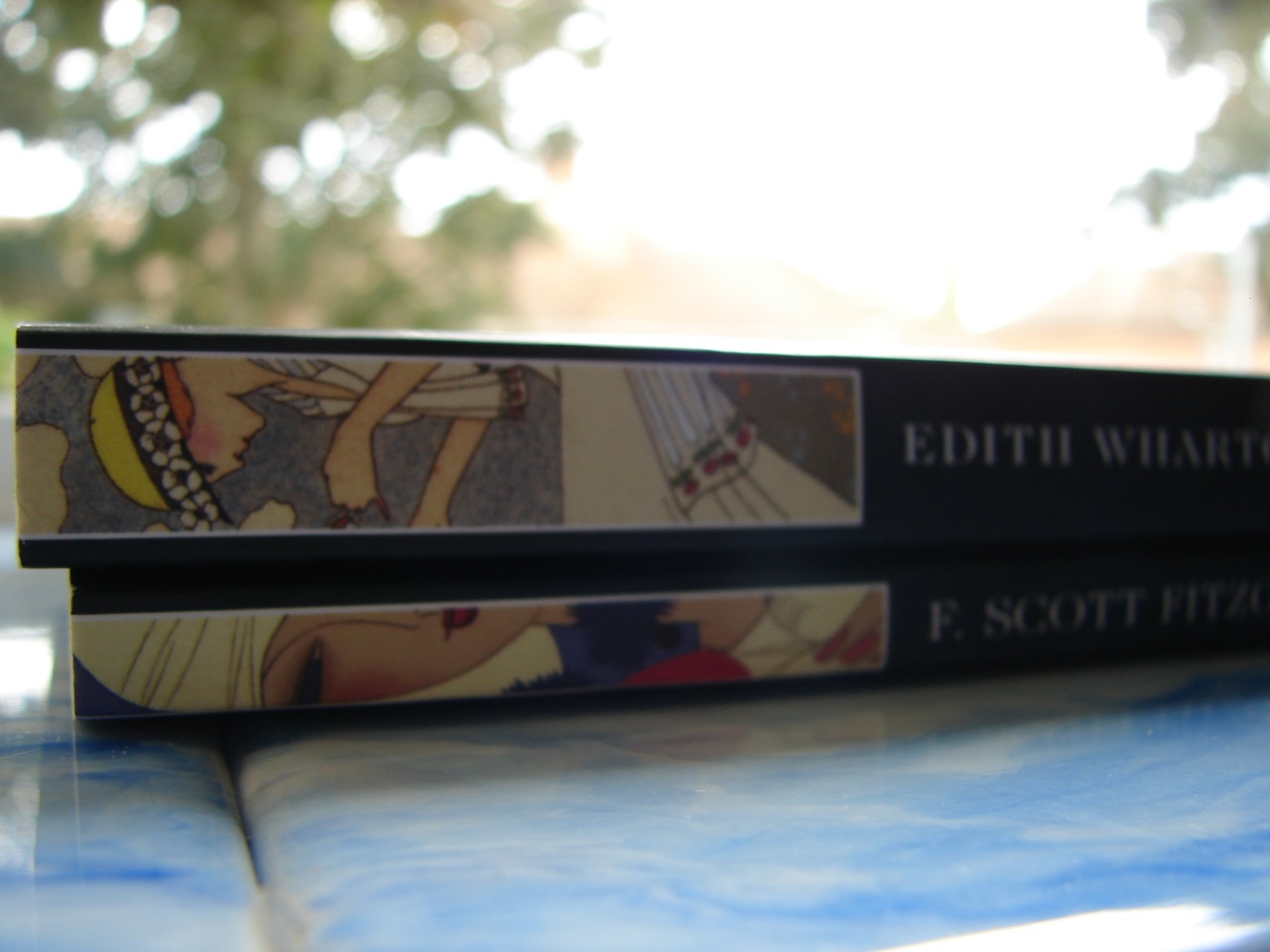
At that point, I figured I needed some sustenance, so I headed for the bakery. But before I could be lured in by the amazing cakes and pastries in the window, I noticed a bookstore right next door! An uncharted bookstore, which I thought I had glimpsed somewhere in the area a few days before but wasn't sure I could find again. That's were my luck turned. They had, inexplicably, a whole shelf of Wordsworth Classics for 2 pounds each. Not even used books. So happy. These books have beautiful cover art and feel like silk. I picked out The Great Gatsby and Age of Innocence.


My only regret was not needing to buy more of them. I also snagged a copy of Henry James' The Ambassadors at that store, not as schnazzy as these books, but still wonderful, especially since it's one of those books whose pages turn beautifully.

Having finally procured a croissant, I wandered over to the next shop, and stopped along the way at the cathedral, where I saw a really wonderful printmaking and calligraphy exhibit. My next find was Absalom, Absalom!, which is surprisingly hard to find in English second-hand stores. Actually most things are hard to find, aside from Jane Austen and Anthony Trollope. I suppose maybe literature of the American south doesn't have much readership here, and I can't say I blame them, because I have yet to learn to love Faulkner. Although he keeps turning up on my reading lists. He's very persistent.

Anyway, I found this very bright red copy, so at least if I start falling asleep while I'm reading, I can just glance at the cover to shock myself awake. Really, the design of book covers is fascinating. I would love to shadow a cover artist or designer on the job or sit in on a meeting between them and the author, if such meetings actually occur.


Later I found another rabbit-warren store, and this time I just cut to the chase and gave my list to the guy behind the counter. He produced an old copy of The Trial, nothing special, but no problem since it was only 2 pounds and I have a nicer copy in German.

And then I relinquished my goal of buying all my books second-hand and headed to Waterstones, which is a chain but which also has a nice café and a giant dalek randomly sitting amongst the bookshelves and lots of copies of The Casual Vacancy that I could peek at and resist buying.

There I found 2666 by Roberto Bolano, which is immense. It's so big. I thought it was several books stacked up until I reached for it and realized it was one book. But it has this wonderful little punched out spot in the cover that you can use to spy on people while you're reading it, and it looks very impressive on the bookshelf.


I found a copy of Lolita that I really like, It's a little smaller and more compact that your average book, with a simple cover design, not too creepy but suggestive.


And The Bell Jar. That one looks a little creepy, actually. I'm not sure I'm looking forward to reading it.


There was also copy of The Crying of Lot 49, but I didn't really care for the cover, and I thought I might find it cheaper online and with a better design - or one that suited me better at least.


And finally, The Emigrants by Sebald. I don't know anything about it, but it looks pretty.


So off I went home with my bag full of books and collapsed in my chair to read another book, Gilead by Marilynne Robinson, which I will review soon, maybe tomorrow after we talk about it in class. Then I can impart to you the wisdom of others as well as myself. Or maybe before class so I can think my thoughts through on paper before the discussion. We'll see.


Sunday, August 12, 2012

More sunny Oxford days

We've been blessed with a few more glorious summer days, so I took tried to spend most of the last two days outside. And just as one of the best things about rainy days is sitting in a cozy armchair and reading a novel, one of the best things about sunny days, I think, is lying in the grass and reading a novel. So out I set, first to the bookstore:


On the way, I admired this cool wall/poster thing they set up outside the construction site of the new Bodleian library extension. It showcases very awesome stuff they have in their collection:


Then I bought a new book, whose cover alone has been catching my eye in various bookstores for months. Spoiler alert: it's quite good so far.


Then I wandered around Oxford a little, threading through clumps of tourists and wedding parties, and photographed a few little details that caught my eye as I went:

 Brain-coral columns and four types of pavement.
 A lovely door that won't let me in to a lovely college (note chain holding it almost shut).

  Puppy and lion gargoyles.

 Oh, what's that? Just a sign announcing the presence of a film crew shooting scenes for the final season of Lewis, the Oxford mystery show. I saw the actual shooting a few weeks ago, stars and all. This time just the sign. 


Finally I arrived at the park, picked a nice tree, settled down under it and opened my new book. There was a tennis tournament happening across the lawn, a smattering of tennis players in white, the comforting thunk of tennis balls meeting rackets, a white marquis tent, and an old-fashioned jazz band playing just loud enough that the strains of music wafted over to where I was sitting. All sorts of people were out and about, playing pick-up soccer, having picnics, taking naps on the grass. The sun was warm, the breeze cool. Perfect bliss. It must be said for cities (despite the bustle, or maybe because of it) that their parks can be really absolutely wonderful.